
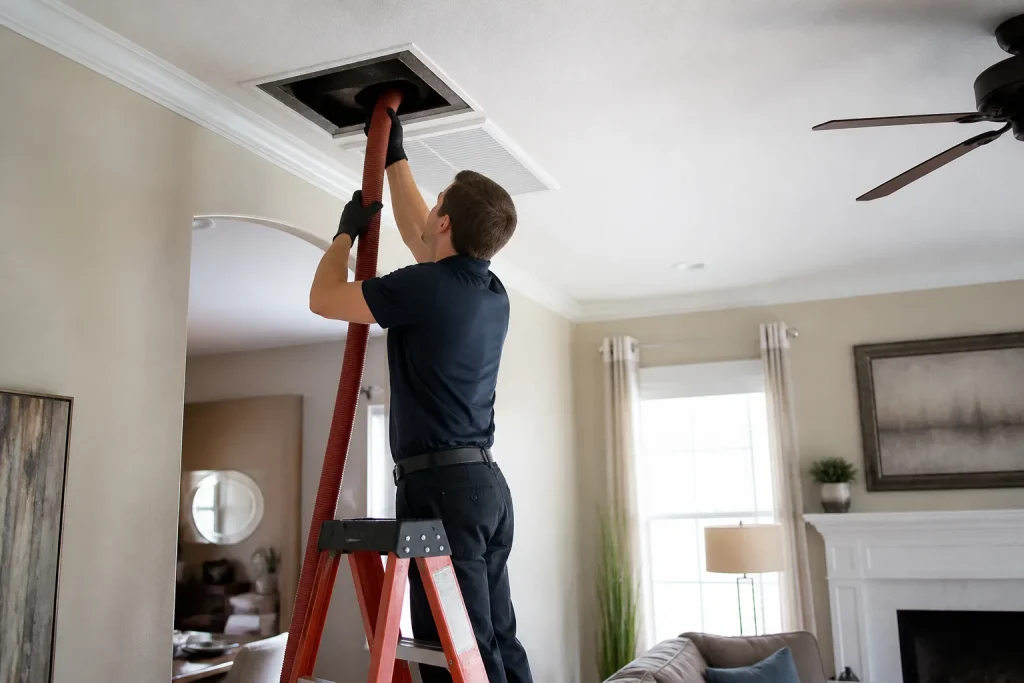
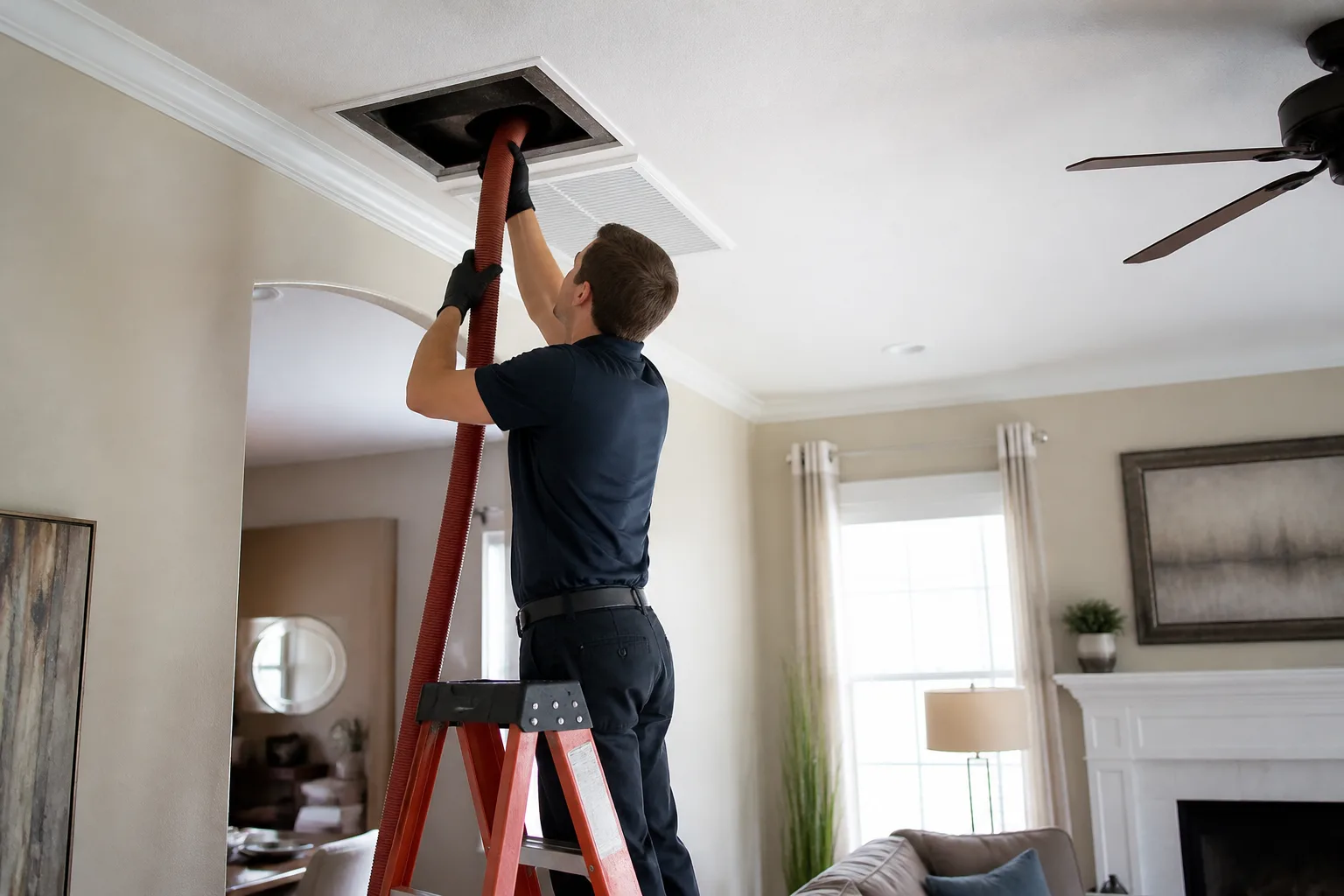
Emergency Air Duct Cleaning Near Me: What Elmhurst Homeowners Should Do First
Before you dial anyone, shut your HVAC system down. That single step is the difference between a contained contamination event and one that gets pushed into every room of your house through the supply registers. We’ve talked to plenty of Elmhurst homeowners who called first and switched the thermostat off second, and by then the blower had already done its work. If you’d rather hand the whole thing to a specialist, call (855) 410-4866. We answer 24/7. Fast dispatch from 7am to 7pm, Sunday through Friday.
What Are the First Three Things to Do Before You Call Anyone?
Shut the system down, find the source, and start a paper trail. In that order. Panic tends to scramble the sequence, and a scrambled sequence is exactly what leaves smoke smell hanging in the walls weeks later.
- Turn off the HVAC at the thermostat, then at the breaker. A system that keeps running keeps circulating soot, sewage odors or rodent debris through the same ducts you’re trying to save. Set the fan to “off,” not “auto,” so the blower can’t cycle back on.
- Identify and isolate the contamination source. A fire in one room, a sewage backup in a basement drain, or a vermin issue in an attic chase each send a different kind of material into the ductwork. Close the registers in the affected rooms if the system has zone dampers, and keep people and pets out of the contaminated space.
- Document everything for insurance. Photograph the source, the damaged areas and any visible debris at the registers. Save receipts for anything you’ve had to throw out. Your adjuster will want a timeline, and a written record beats a memory every time.
One thing not to do: don’t run a household vacuum over the registers or spray air freshener into them. Both push the problem deeper and can complicate what a professional is later able to remove.
Is It a True Emergency or Just Urgent? A Quick Triage
Not every dirty-duct call is an emergency, and treating a dusty system like a hazmat scene just costs you sleep. Here’s how we sort it.
True emergency: biological contamination moves to the front of the line. That means fire soot and smoke residue, sewage backup that reached the ductwork, or a vermin infestation with droppings in the system. These involve contaminants you don’t want circulating while you wait a week for a slot. Mold growth inside ducts, especially with a musty smell that won’t clear, belongs here too.
Urgent but not an emergency: heavy dust buildup, pet dander, a sudden spike in allergy symptoms, or a system that’s clearly running less efficiently. Real problems, worth scheduling promptly, but they don’t carry the same health and contamination risk as soot or sewage.
- Smoke or soot after a fire: emergency
- Sewage odor or visible backup in ducts: emergency
- Rodent or bird activity in the duct system: emergency
- Visible mold or a persistent musty smell: treat as urgent, schedule fast
- Heavy dust, dander, general buildup: standard scheduling
If you’re not sure which bucket you’re in, describe what you’re seeing to whoever answers the phone. A technician with up to 13 years of experience can usually tell from a short description whether you need same-day attention or a normal appointment.
What Information Should You Have Ready When You Call?
Good dispatch starts with good information. The more you can tell us, the more likely the right equipment shows up on the first visit instead of the second. Have these ready:
- The type of contamination (soot, sewage, vermin, mold, dust) and roughly how far it spread.
- When it happened and whether the HVAC has been running since.
- The system type – forced air, and roughly how many returns and supplies you can count.
- Whether it’s a single-family home or an attached unit, and if neighbors might be affected.
- Any insurance claim number or adjuster contact.
- Access notes – attic hatch location, basement layout, anything a technician should know.
This matters because professional-grade systems like Rotobrush and Nikro are configured differently depending on the job. A soot remediation and a vermin cleanup don’t call for the same setup, and knowing ahead of time means one trip instead of guesswork. If the source is biological, sanitizing with something like Abatement Technologies products may be part of the plan, and that’s easier to schedule when the scope is clear from the start.
Why Emergency Duct Cleaning Often Takes Two Visits
Here’s the part that surprises people: a serious contamination event usually needs containment first and deep cleaning second. Skipping the containment step is how odors come back a month later.
The first visit focuses on stopping the spread – sealing off the affected sections, removing the source material, and setting up negative pressure so contaminants don’t drift into clean rooms. The second visit is the deep clean: mechanical agitation of the duct walls, HEPA extraction, and sanitizing where biological contamination was present. In between, you may be asked to keep the system off or run it only on a limited basis.
For a routine cleaning rather than an emergency, the process is simpler, and you can read more about what a standard air duct cleaning involves. If the contamination came through a fire or water event, the HVAC unit itself often needs attention too – that’s HVAC cleaning, and it’s a separate step from the ducts. Same story for a dryer vent cleaning after lint buildup or a near-miss: it’s its own job with its own risks. We handle all of it as one system, because a duct that’s clean but feeding a contaminated coil doesn’t solve much.
How Elmhurst’s Attached Housing Changes the Picture
Elmhurst has a lot of attached and semi-attached housing – rowhouses, two-family homes, buildings where one unit shares a wall or a chase with the next. That layout complicates contamination events in ways a detached house doesn’t have to worry about.
Smoke, sewage odors and even rodent activity can travel through shared voids, and ductwork that runs close to a party wall can pull air from an adjacent space. If your neighbor had the same fire, flood or pest issue, coordinating timing matters: cleaning one unit while the source is still active next door can mean a repeat visit. It’s worth a quick conversation with the neighbor before the technician arrives. We’ve seen jobs go smoother when both sides know what’s happening and when.
Duct integrity is the other piece. Older attached homes often have leaking joints and failing seals, which means contamination can seep back in even after a thorough cleaning. That’s where Duct Repair & Sealing earns its place in the plan. Cleaning-only outfits leave the leaks behind; sealing them is what keeps the fix from unraveling. It’s a big part of why we treat the whole indoor air system as one connected thing rather than five separate errands.
When to Call a Pro (and When to Wait)
Call a professional when the contamination is biological, when the source is unclear, or when the system itself has to be assessed for damage. Soot, sewage, mold and vermin all fall in that category – these aren’t cleanups to attempt with a shop vac and a mask. Call us the moment the HVAC is off and the source is isolated, and we’ll walk you through what comes next.
Wait, or simply schedule normally, if it’s dust, dander or general buildup with no health concern attached. That’s maintenance, not an emergency, and it doesn’t need a midnight scramble.
Related services in Elmhurst: if you’re starting from scratch, our Elmhurst Air Duct Cleaning page covers the full-system approach, and each service above has its own page for the details.
The Bottom Line
Shut the system down first, isolate the source, and document everything. Then call someone who can tell an emergency from an urgent job and dispatch the right equipment. A two-visit protocol – containment, then deep clean – is normal for serious contamination, and in attached Elmhurst housing it pays to loop in the neighbor. Trusted brands like Honeywell and Aprilaire matter, but they only help when they’re applied by specialists who also repair what they find. Our technicians have up to 13 years of experience, and the local pro we connect you with is licensed and insured as their state requires.
If you’re in Elmhurst and need help, Elmhurst Air Duct Cleaning offers free estimates – call (855) 410-4866. We answer 24/7. Fast dispatch from 7am to 7pm, Sunday through Friday.
Frequently Asked Questions
There’s no fixed price, and anyone quoting a number before seeing your system is guessing. Cost depends on the type of contamination, how far it spread, and whether Duct Repair & Sealing or HVAC cleaning is also needed. The written estimate sets the final price. Call (855) 410-4866 for an exact quote – estimates are free.
No. Running the system circulates the contamination through every supply register in the house, which spreads soot or sewage odor into rooms that were never affected. Keep the system off until a technician has assessed it. Call (855) 410-4866 and we’ll tell you what to do next.
A low quote usually reflects a surface-only job – a quick pass with consumer-grade equipment that misses the duct walls and doesn’t address leaks or biological contamination. Professional-grade systems like Rotobrush and Nikro cost more to run, and a real job often includes a second visit for deep cleaning. Ask what equipment a company uses and whether they repair duct integrity. Call (855) 410-4866 for a straightforward comparison.
Most homes don’t need it on a strict schedule. After a fire, sewage backup or pest event, it’s necessary immediately. Otherwise, every few years or when you notice dust buildup, musty odors or efficiency problems is a reasonable guide. In attached Elmhurst housing, a neighbor’s event can be your cue. Call (855) 410-4866 if you’re unsure whether it’s time.
Written by the team at Elmhurst Air Duct Cleaning.
Need Air Duct Cleaning Help?
Call Elmhurst Air Duct Cleaning - the local pro we connect you with is licensed and insured, with free written estimates in Elmhurst.
(855) 410-4866